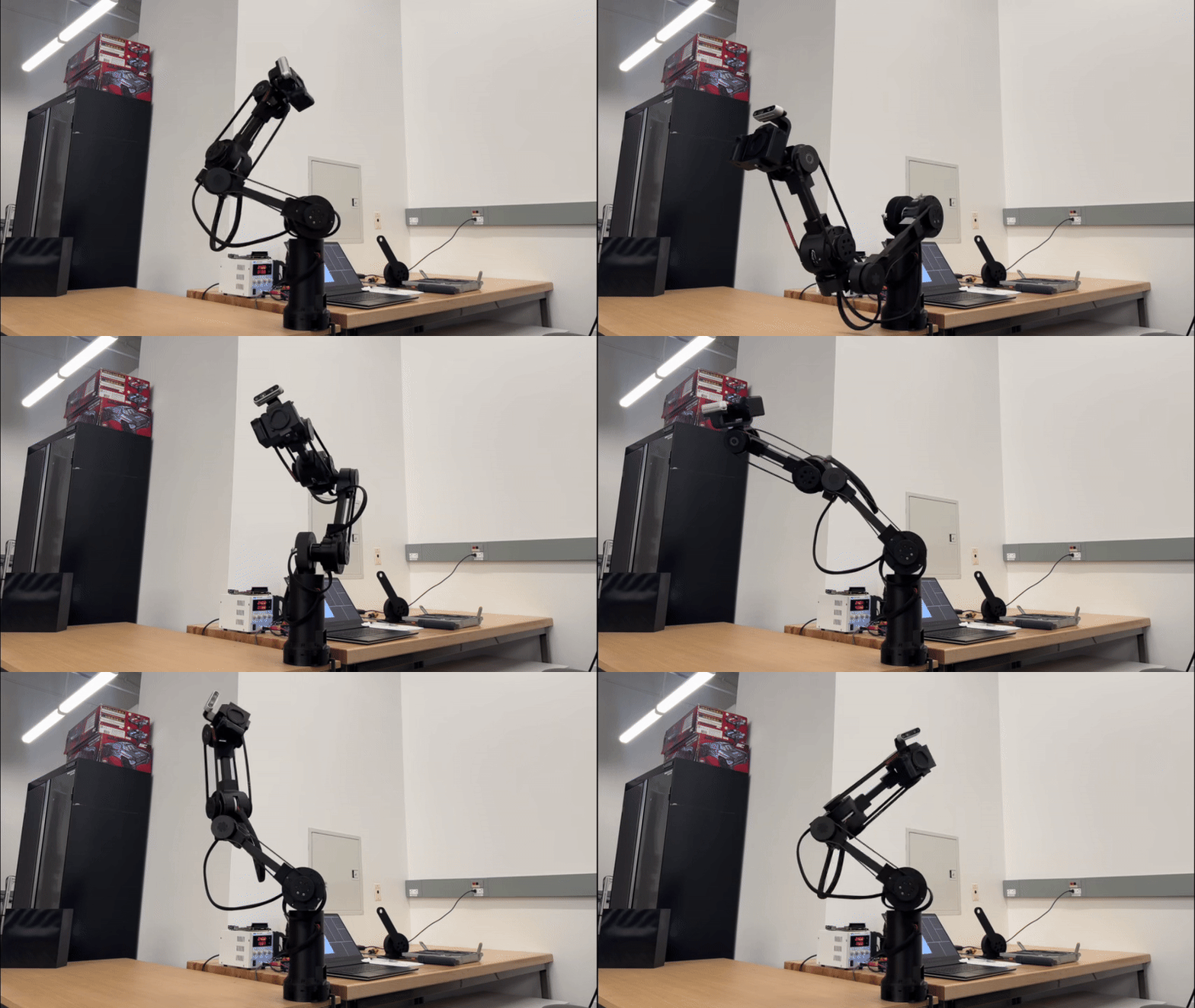
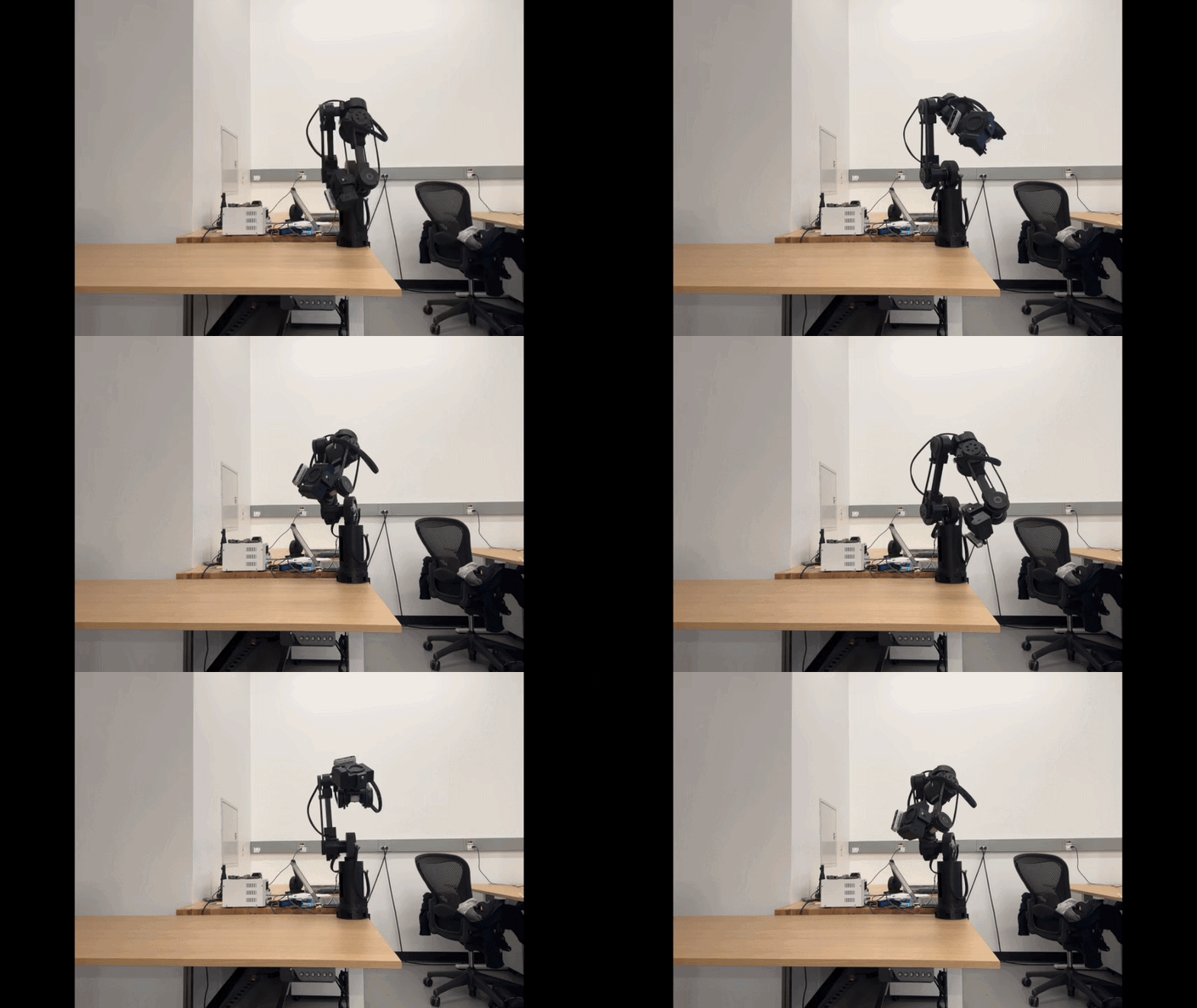
Fully 3D-printed 6-DOF arm — STEP files, bill of materials, actuator specs, and validated performance results.
Six-link serial chain in a modified PUMA configuration. All structural components are 3D-printed PLA at 30% infill. Carbon-fiber tubes carry the primary bending load between shoulder and elbow.
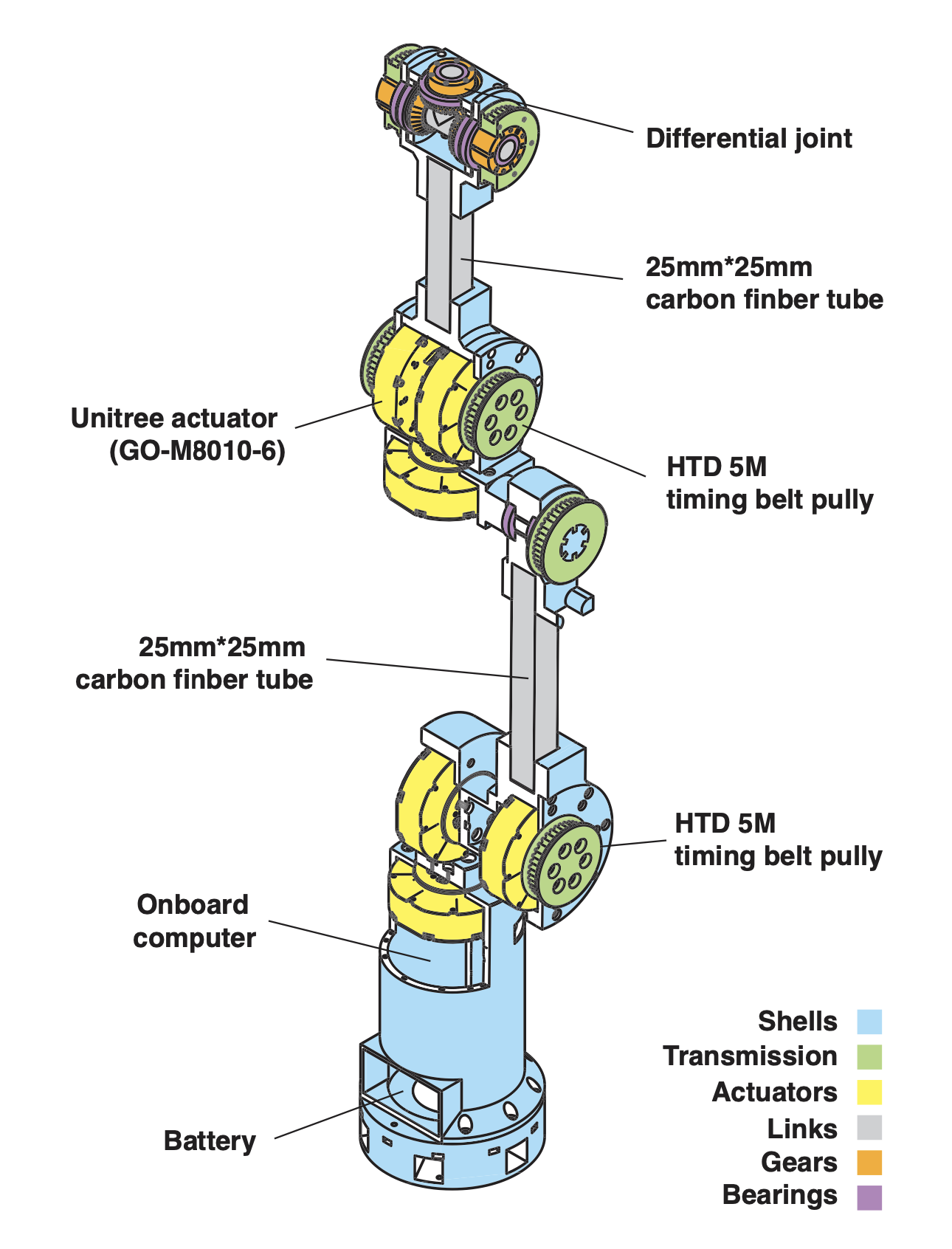
Mechanical assembly — joint layout and link geometry
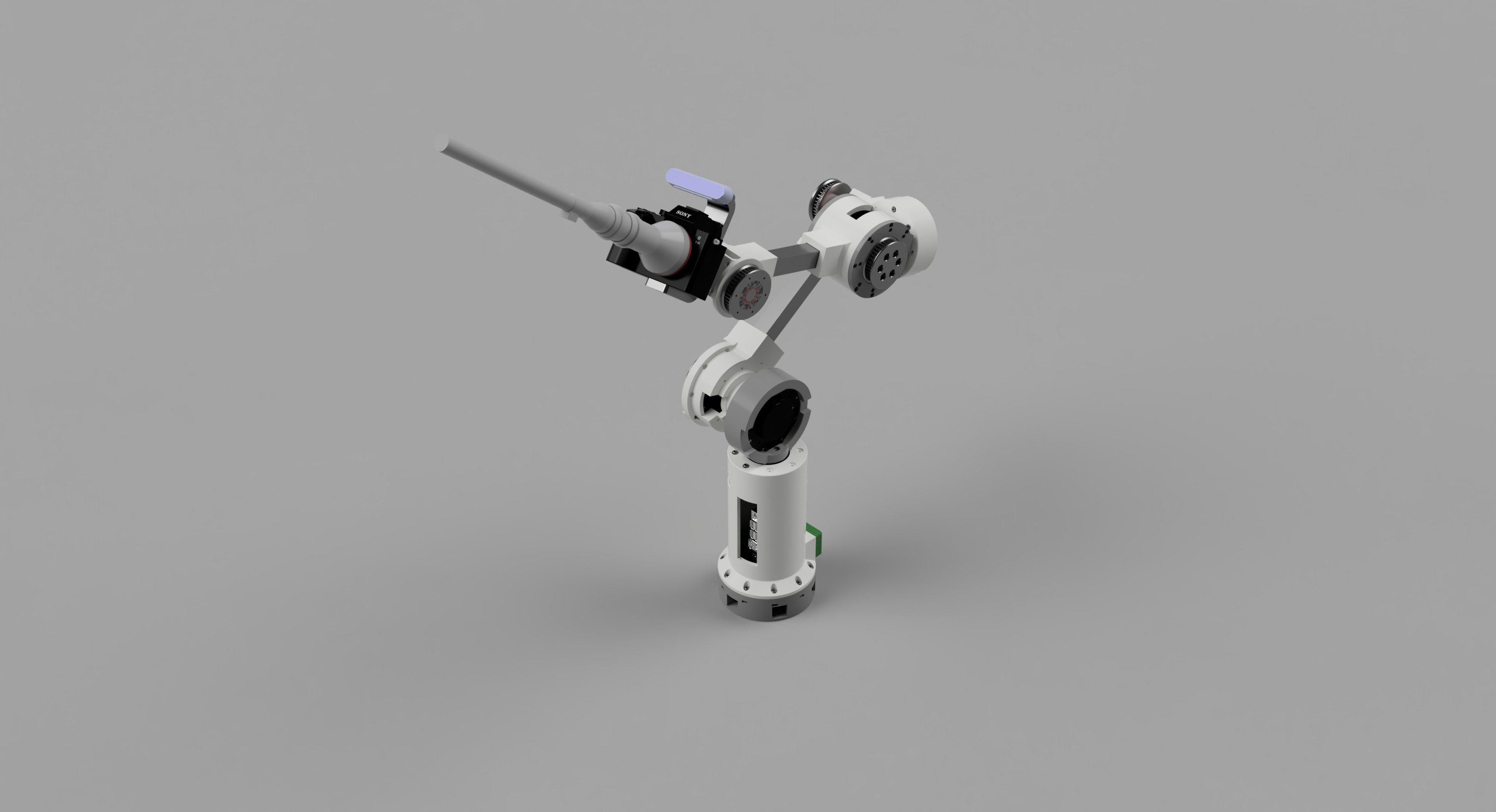
CAD render
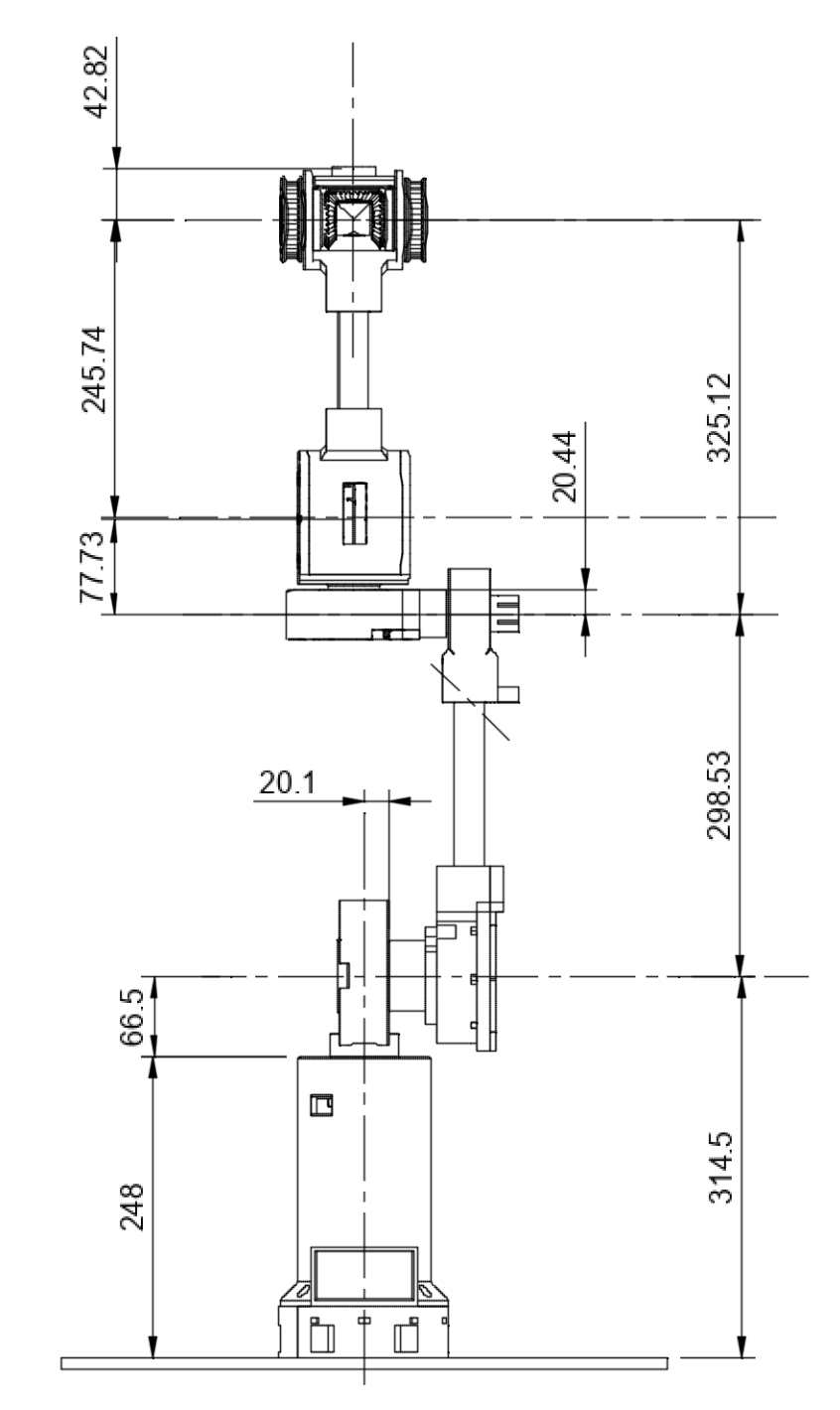
Workspace dimensions
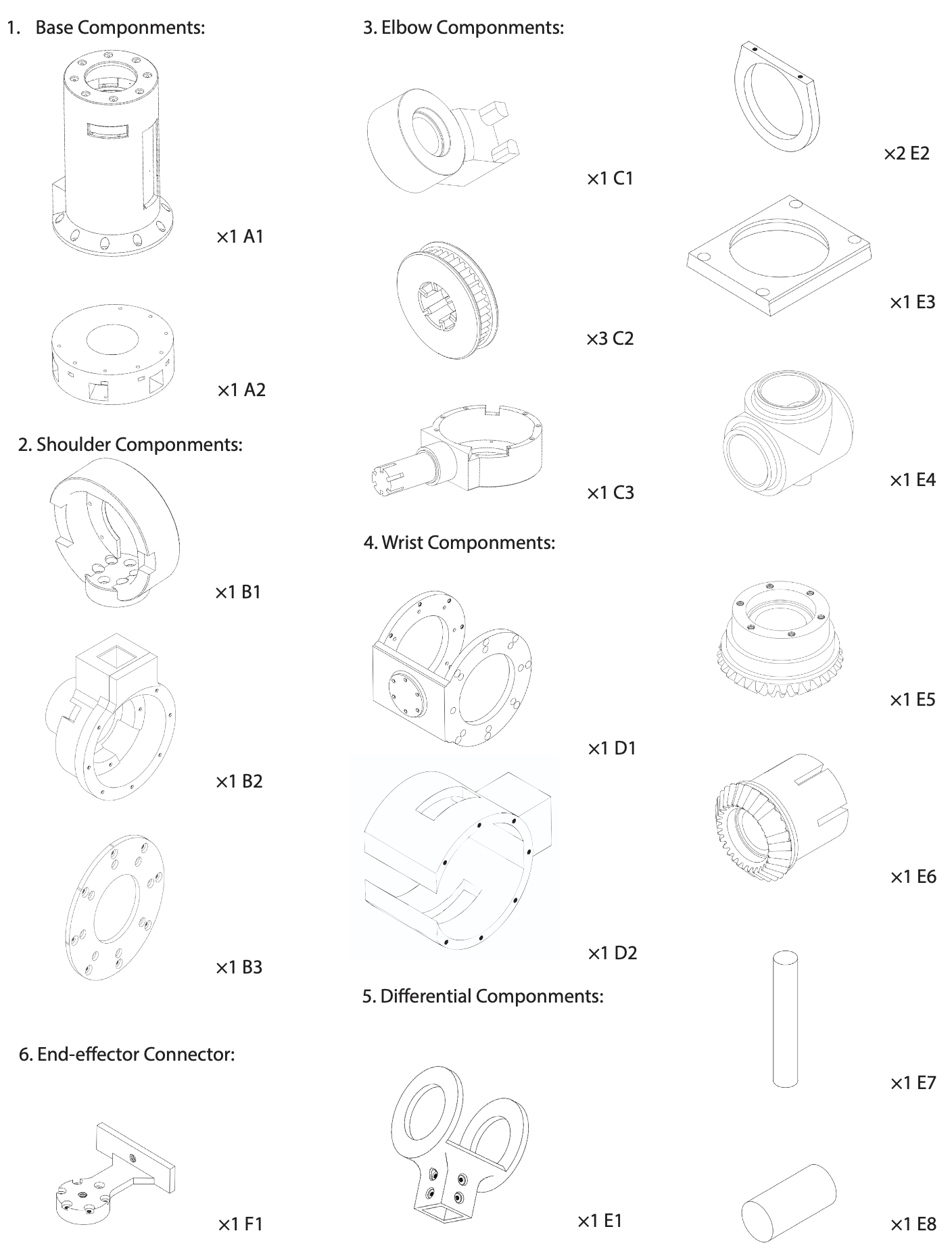
Every structural link, joint housing, bearing seat, and motor mount is 3D-printed. Designed for BambuLab printers at 30% infill with standard 0.4 mm nozzle.
All 3D-printed components laid out
| Category | Item | Qty | USD |
|---|---|---|---|
| Actuators | Unitree GO-M8010-6 | 6 | $69.65 ea |
| Linkages | Carbon fiber tube 25×2 mm, 500 mm | 1 | $27.40 |
| Bearings | 26×17×5 mm | 2 | $1.59 |
| 50×40×6 mm | 6 | $2.61 | |
| 42×30×7 mm | 5 | $2.43 | |
| Transmission | HTD-5M belt 150T (750 mm) | 1 | $15.19 |
| HTD-5M belt 160T (800 mm) | 2 | $15.56 | |
| Fasteners | M4 + M3.5 screw sets | 2 | $27.04 |
| Vision | Intel RealSense D435 | 1 | $163.63 |
| Compute | NVIDIA Jetson Nano | 1 | $216.15 |
| Electronics | RS-485 Hub, Power Supply (≥300 W) | — | $35.96 |
| 3D Printing | PLA @ 30% infill (BambuLab) | 1 | $16.99 |
| Misc | Wire sleeving | 1 | $9.26 |
| Total | ~$992 | ||
Six quasi-direct-drive BLDC motors with a 9:1 gear ratio. Low reduction enables compliant, backdrivable motion — critical for kinesthetic teaching.
| Parameter | Value |
|---|---|
| Type | Quasi-Direct Drive BLDC |
| Peak Torque | 23.7 N·m |
| Rated Torque | 6 N·m |
| Max Speed | 45 rpm (no load) |
| Gear Ratio | 9:1 |
| Encoder | 14-bit absolute |
| Interface | RS-485 |
| Control Rate | 200 Hz |
| Modes | MIT / Position / Velocity / Torque |
| Weight | 485 g each |
MIT mode sends simultaneous position, velocity, and feed-forward torque each cycle — enabling smooth impedance control for cinematic motion.
All six motors share a single RS-485 daisy chain. The hardware driver runs a 200 Hz closed-loop, sending MIT-mode packets with position, velocity, and feed-forward torque simultaneously.
Low-level actuator control — position tracking results across all joints
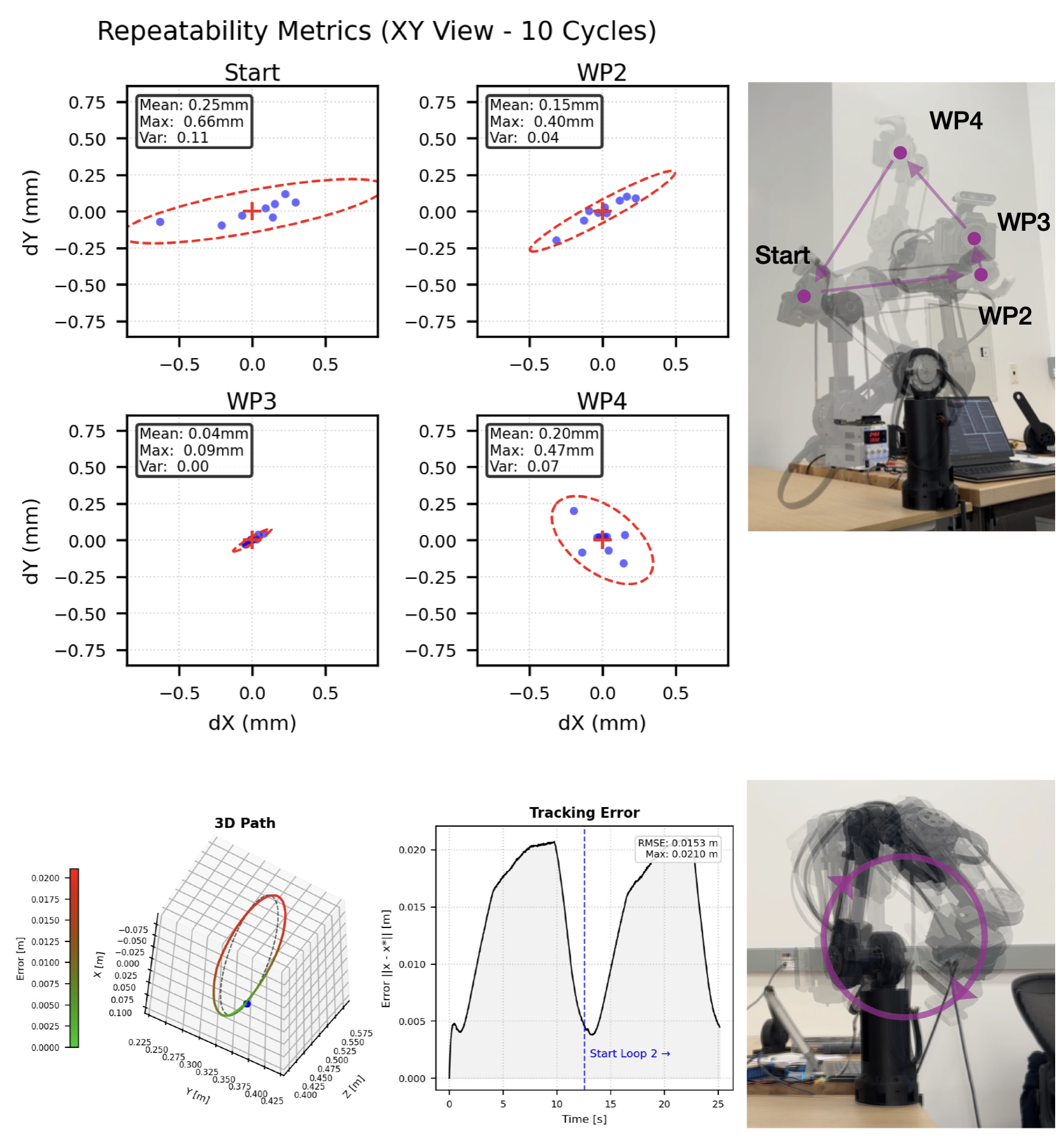
Repeatability and path-following accuracy measured on real hardware. Both tests run with the 200 Hz RS-485 control loop.
Same trajectory executed five times. End-effector returns to within ~1 mm of the starting position each run.
End-effector tracks a planned Cartesian path in real time. Demonstrates smooth motion under the impedance control loop.
Mounted at the end-effector. Provides synchronized RGB and depth for visuomotor policy training and deployment.
A detailed illustrated guide with photos, torque specs, and wiring instructions is being prepared.
Follow on GitHubcalibrate_joint_states.py.