Humanoids ◆ Locomotion control ◆ Survey ◆ Science Robotics 2026 ◆ A personal reading companion, not the official site
Evolution of Humanoid Locomotion Control
Sixty years of making two-legged machines stay up, in three eras: classical feedback and predictive control on physics models, reinforcement learning in massively parallel simulation, and the generative models now arriving. This page is a reading companion to the survey I co-authored — every one of its 280 references, sorted by the method it belongs to, the subject it is about and the year it appeared, each with a link to the paper itself, alongside the equations the classical methods are actually written in.
NOT THE OFFICIAL SITE
This is a personal page by one of the paper's authors, made as a way to read the survey and find its references; it is not endorsed by the co-authors, Purdue's TRACE lab, or Science Robotics. The paper is at doi:10.1126/scirobotics.aed3973 and the official companion material (figures, the curated reading list) at github.com/purdue-tracelab/Humanoid-Locomotion-Survey. The categorisation, the equations and the timeline notes on this page are mine.
How this page is built
Every list here comes from the manuscript itself. The reference list is parsed in full, and each paper is placed by the section of the survey that cites it — the authors' own placement, not my opinion of where it belongs. On top of that, each paper is tagged by subject from its title, which is what the filters and the search use. Papers appear in more than one place when the survey cites them in more than one place.
How the links and the categories were checked
Placement. A paper's method family is decided by which section of the survey cites it, read straight out of the manuscript. All 280 references are cited somewhere in the body, so none is stranded. The manuscript writes no citation ranges and numbers no equations, so the scan can neither miss a citation written as a range nor mistake an equation number for one; line-level spot checks put each reference in exactly the sections shown here.
Links. Every DOI on this page was fetched back from Crossref and its title compared with the title in the survey's own reference list. — agreed and were kept; the ones that did not were dropped rather than shipped. Those failures were all textbooks, which Crossref matches to published reviews of themselves — Raibert's Legged Robots That Balance resolved to a 1986 IEEE Expert review of it — so the five books here link to their publishers by hand instead.
Published versions. Where a reference is a preprint, arXiv is asked directly whether it was later published, since the authors record that themselves. Where it was, the page links the publisher and keeps the preprint beside it. — references have no DOI and no repository link at all — preprints and workshop papers that Crossref does not index, such as Isaac Gym, PyBullet and Dreamer — and those fall back to a title search.
One correction worth naming: the survey cites “Towards Versatile Humanoid Table Tennis”, and that preprint has since been renamed “PACE”. The arXiv link is the same paper; the page says so on the entry rather than silently showing a different title.
280
references
every work the survey cites, parsed from the manuscript
17
method families
one per section of the survey, from analytical models to foundation models
30
subjects
world models, diffusion, MPC, hybrid zero dynamics, sim-to-real, and the rest
3
eras
classical from the 1960s, learning-based from 2015, emerging from 2023
25
milestones
on the timeline, with the survey's reference numbers
Three eras
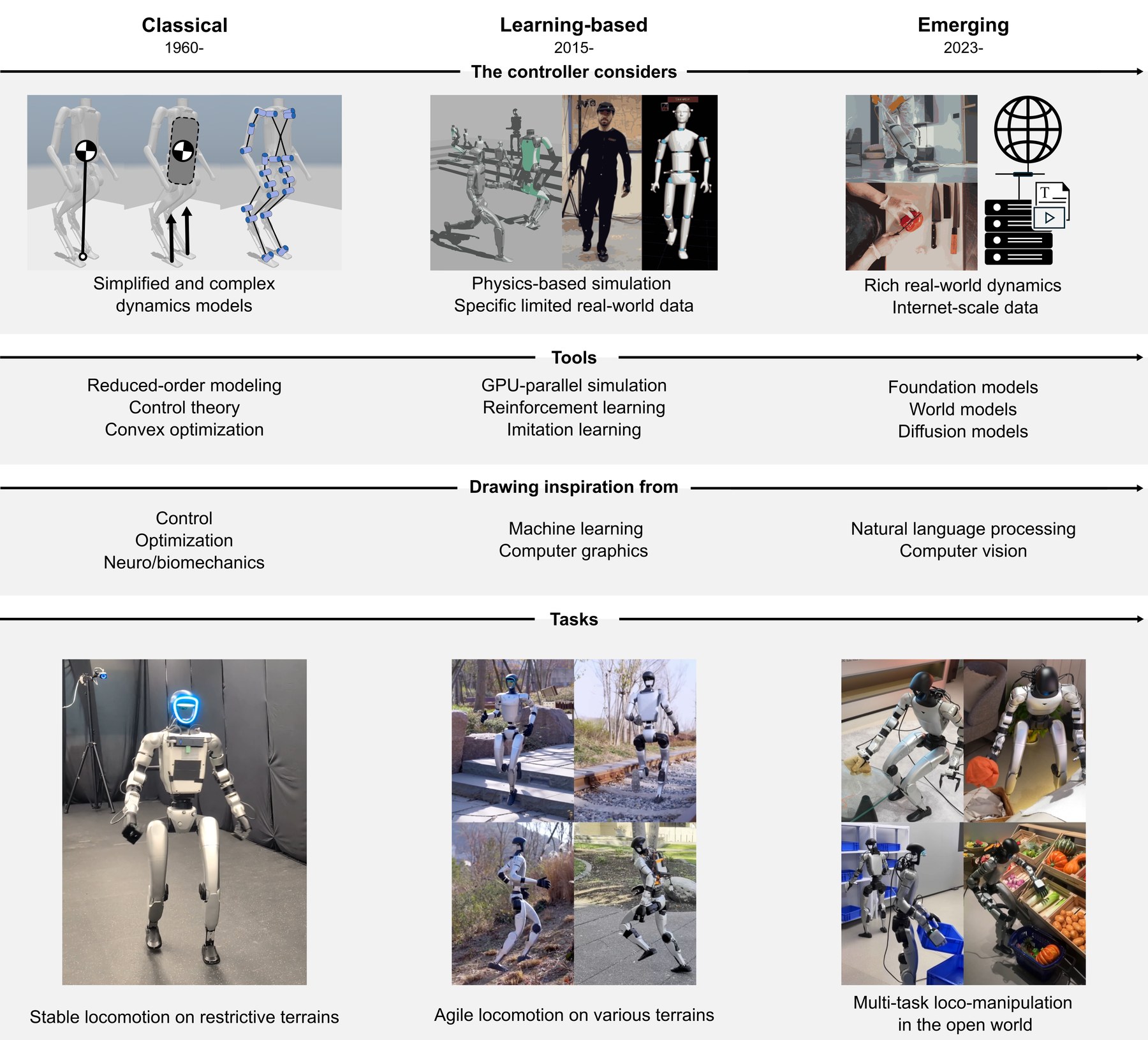
The survey's first move is to name the eras by what the controller is allowed to consider and which tools it borrows (Fig. 1, Table 1). Each era widened the scope of reasoning, from reduced-order models to simulated and then real-world physics, and each borrowed from a new field.
CLASSICAL1960s–
Physics you can write down
considers
simplified and complex dynamics models
tools
reduced-order modelling, control theory, convex optimisation
borrows from
control, optimisation, neuro- and biomechanics
achieved
stable locomotion on restrictive terrains; ZMP walking, Raibert's hoppers, HZD, the DARPA Robotics Challenge, Atlas' parkour
LEARNING-BASED2015–
Physics you can simulate at scale
considers
physics-based simulation, specific limited real-world data
multi-task loco-manipulation in the open world; reliability is the open question
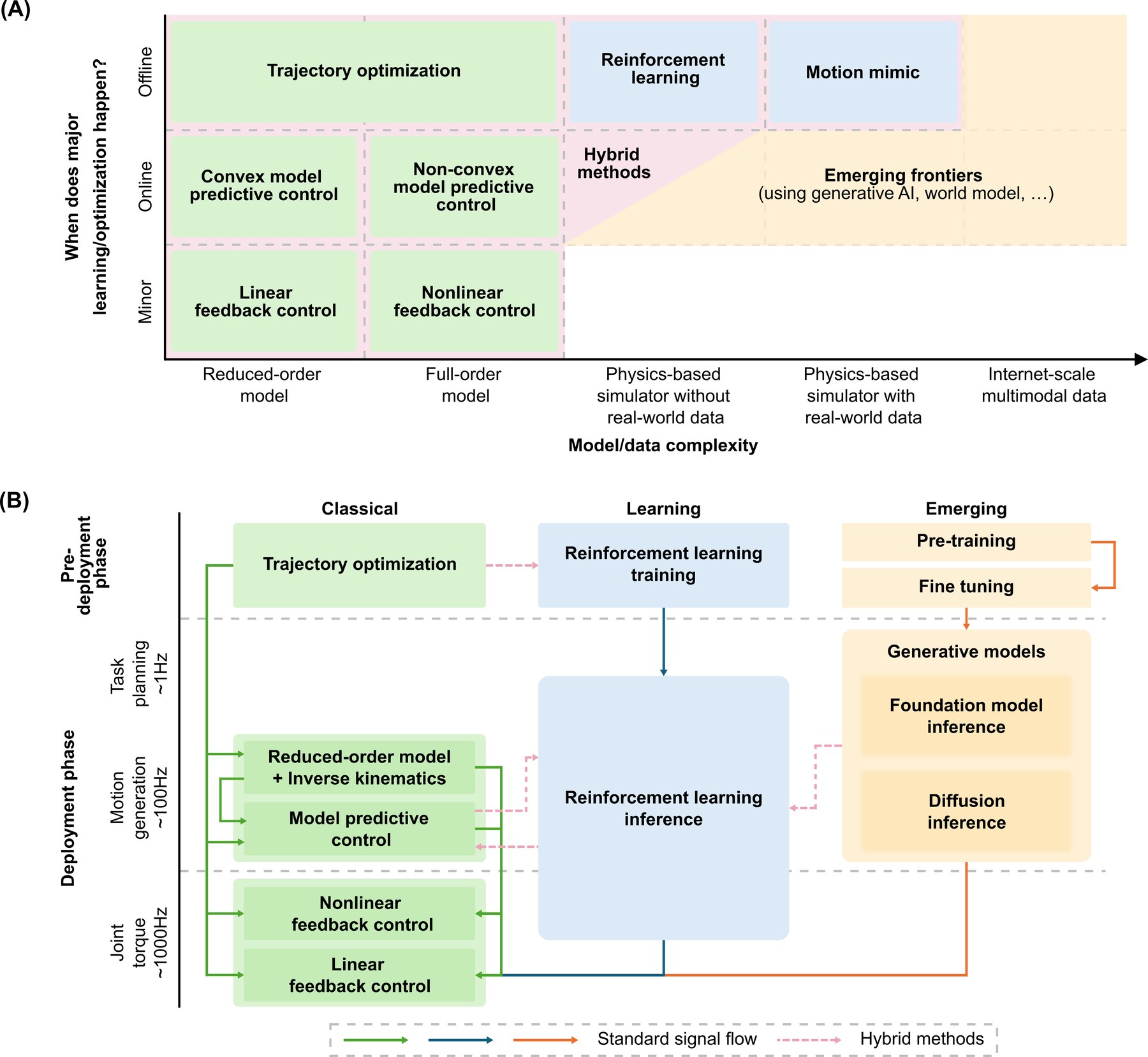
The survey's Fig. 1. Evolution of humanoid locomotion control paradigms over the past several decades, from classical methods to learning-based approaches and into an emerging era driven by generative AI. Images from Unitree (G1) and Vazquez88 (motion capture), as credited in the paper. Figure from the companion repository.The survey's Fig. 1. Evolution of humanoid locomotion control paradigms over the past several decades, from classical methods to learning-based approaches and into an emerging era driven by generative AI. Images from Unitree (G1) and Vazquez88 (motion capture), as credited in the paper. Figure from the companion repository.The survey's Fig. 3. The unified view: a deliberative System 2 that reasons slowly over goals and semantics above a reactive System 1 that closes the loop on the body. Classical hierarchies, learned policies and foundation-model stacks all fall into this picture; what changes between eras is which layer is written down and which is learned.
The milestones, in order
Twenty-five milestones the survey cites, on the eras it defines, running down the page so that the list can keep growing without anything colliding. Dates are first public appearances; the notes are mine, the reference numbers are the paper's.
The methods, and every paper behind them
One entry per section of the survey. Open a family for what it is, the equations it is written in where it has them, and the complete list of references the survey cites there — each linked to the paper. The loop rate and the compute beside a family are properties of that layer, as the survey describes it in Fig. 3, not measurements of any individual paper.
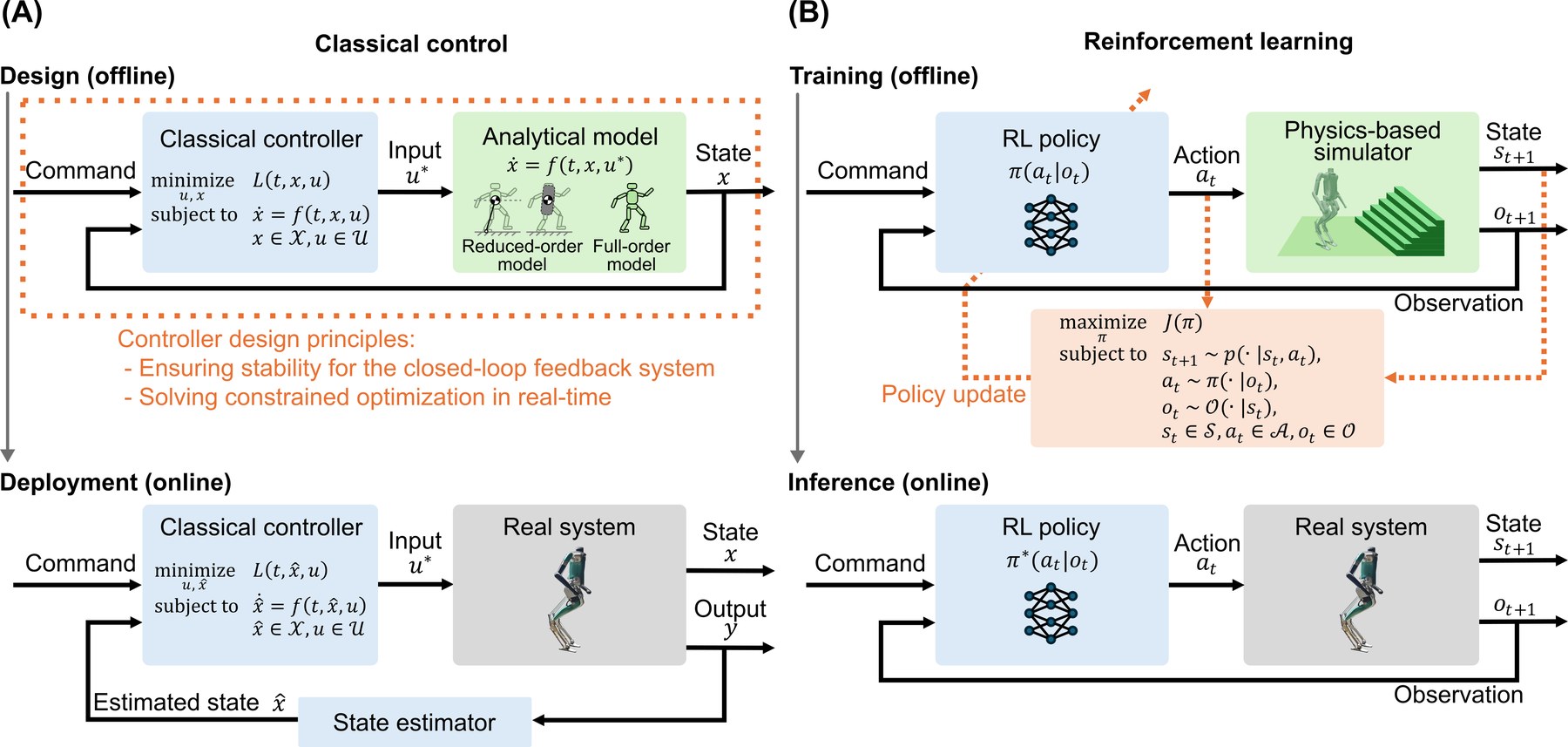
The survey's Fig. 4. The learning-based pipeline the middle era converged on: pre-training in massively parallel simulation with randomised dynamics, then fine-tuning and deployment, with the reduced-order model and inverse kinematics still present as the thing the policy is trained against. Figure from the companion repository.
Five shifts under way
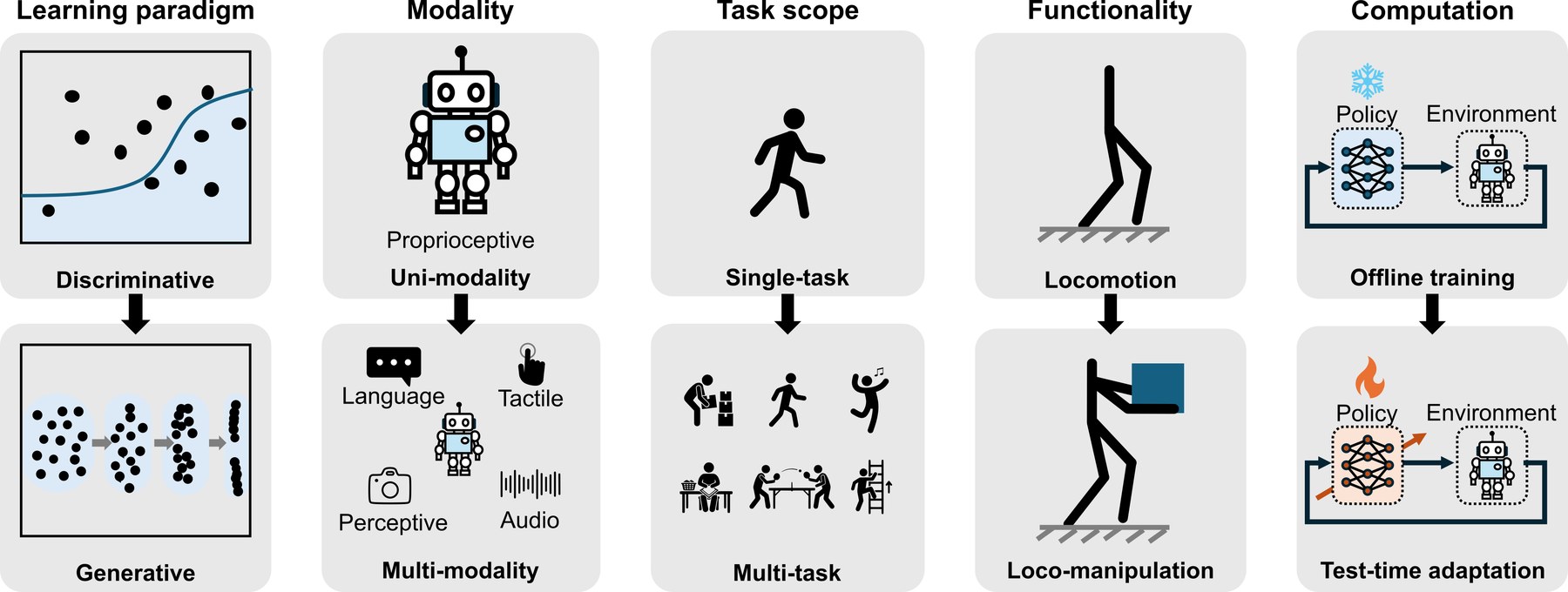
The emerging era is not one method but a direction of travel. The survey names five shifts (Fig. 5). For each, the work the survey cites on the far side of the shift, and the line of work it grew out of — so the change can be read as a continuation rather than a break.
The survey's Fig. 5. Emerging research shifts in humanoid control across five dimensions: learning paradigm, modality, task scope, functionality and computation. Figure from the companion repository.
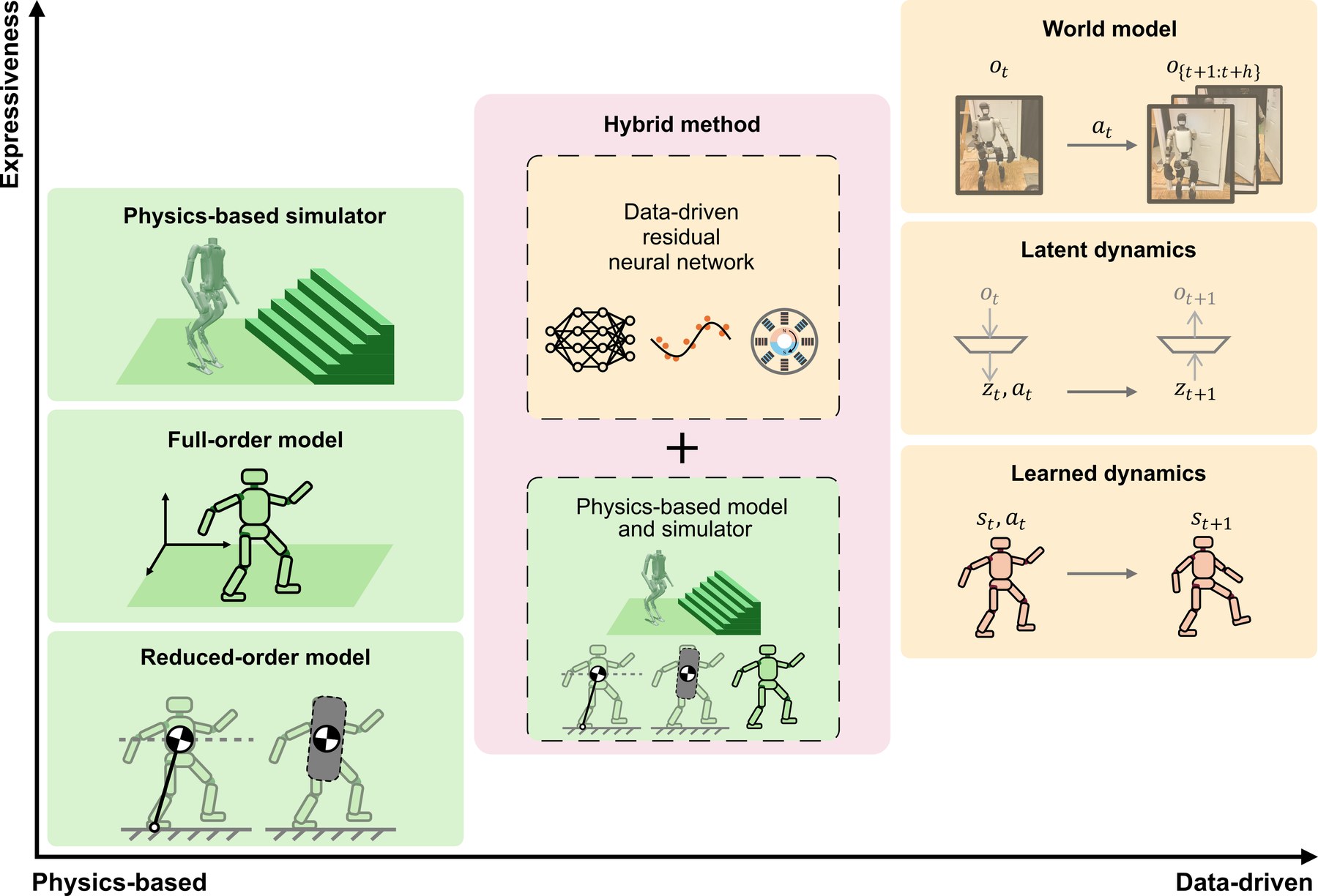
Models and simulators, from physics-based to data-driven
The survey's Fig. 2 lays the models a controller can be written against on one axis, from those you derive to those you fit. Where a method sits on that axis decides what it can express, what it costs to evaluate, and how it fails when the world disagrees with it. Open the count in the last column to see the references behind each row, and the rule that selected them.
◆ scroll the table sideways
The survey's own list of tools to start from: model-based, the MIT Cheetah software, OpenLoong, CasADi, acados, OCS2 and Judo; learning-based, Isaac Lab, MuJoCo Playground, MJLab, and Newton and Genesis for large-scale differentiable simulation. Every one of them is in the library below — filter by the simulators subject.
The survey's Fig. 2: the spectrum of models. Reduced-order models, full-order models and simulators on the physics side; learned dynamics, latent dynamics and world models on the data side; hybrids in between, such as learned actuator models and residual dynamics.
The library: all 280 references
Search by anything on the row — title, author, venue, year, method or subject — and narrow it with the filters. Clicking a subject anywhere on the page filters to it, so “world models” or “hybrid zero dynamics” is one click. Every row links out: a DOI where Crossref has one, the arXiv or repository link the reference itself carries, otherwise a title search.
years –
The method family column is where the survey cites the paper; the loop rate is the rate the survey attributes to that layer, not a number from the paper. A paper cited in several sections carries several families.
What the survey asks of the next decade
Safety and reliability first. Falling is the barrier to deployment. The paper calls for standardised recovery and impact tests, compliant and energy-dissipating hardware, and test-time adaptation, so that a humanoid outside the laboratory fails gracefully rather than catastrophically.
Then accessibility. Platform costs have already dropped by an order of magnitude; open hardware and open toolchains decide whether the field's progress is reproducible by more than a handful of groups.
Then the integration of control with perceptual and cognitive intelligence in a two-level hierarchy — a reactive motor layer under a deliberative one — and, further out, an ecosystem of networked embodied agents.
The conclusion the authors draw is that the recent leap in agility is not the triumph of neural policies alone but of contact-rich simulation, expressive architectures, physics-guided training design and asymmetric training together. Physics did not get replaced; it moved into the simulator, the reward, the curriculum and the real-time interface.
The 31 references behind the open challenges and the recommended entry points are under Open challenges and getting started in the methods above, and filterable in the library by the outlook era.
Three principles that survive every era
Physics-based modelling. Whether written down, simulated, or learned, a model of the body is what the controller reasons against.
Constrained decision making. Support polygons and torque limits in the classical era; reward shaping, curricula and action limits in the learning era; conditioning and filtering in the emerging one.
Adaptation to uncertainty. Adaptive and robust control, then domain randomisation, then in-context and test-time adaptation. The survey's argument is that these are the same problem in three vocabularies.
Getting started, as the survey recommends
Hardware: build or buy
Open-source platforms (Berkeley Humanoid, Berkeley Humanoid Lite, Stanford ToddlerBot) maximise flexibility; commercial ones (Unitree G1 and H1, Booster T1 and K1, Agility Digit, Apptronik Apollo) maximise productivity with safety-tested hardware and vendor support.
Software
Model-based: MIT Cheetah software, OpenLoong, CasADi, Acados, OCS2, Judo. Learning-based: Isaac Lab, MuJoCo Playground, MJLab, and Newton and Genesis for large-scale differentiable simulation. Data: AMASS and pipelines like BeyondMimic.
Core references
Feedback Control of Dynamic Bipedal Robot Locomotion and Robot Modeling and Control for the classical half; Reinforcement Learning: An Introduction and PPO for decision making; DreamerV3 for world models; Deep Learning, VAEs and the principles of diffusion for the generative foundations.
A practical RL progression, from the paper
1
install Isaac Sim and Isaac Lab
2
execute a walking policy in simulation
3
train balancing and walking controllers
4
condition on a commanded velocity
5
track human motion
6
learn perceptive locomotion on rough terrain
7
deploy the learned policies on hardware
The companion reading list, by section
From the official repository, which organises the papers the survey cites; the sections still being filled in there are omitted here. Follow the repository for the complete, maintained list.
Evolution of Humanoid Locomotion Control. Yan Gu*, Guanya Shi*, Fan Shi*, I-Chia Chang, Yen-Jen Wang, Qilong Cheng, Zachary Olkin, Ivan Lopez-Sanchez, Yunchu Feng, Jian Zhang, Aaron D. Ames, Hao Su†, Koushil Sreenath† (* equal contribution, † corresponding). Science Robotics 11(117), eaed3973, 2026. doi:10.1126/scirobotics.aed3973.
Figures 1 to 5 are the paper's, taken from the companion repository, and the era descriptions and getting-started notes follow the paper's text. The categorisation of the references into method families and subjects, the equations written out, the timeline and its notes, and the wording throughout are mine and are not part of the paper. Reference metadata and DOIs come from the manuscript's own reference list and from Crossref. This page is a personal reading companion and not the official site of the survey.